
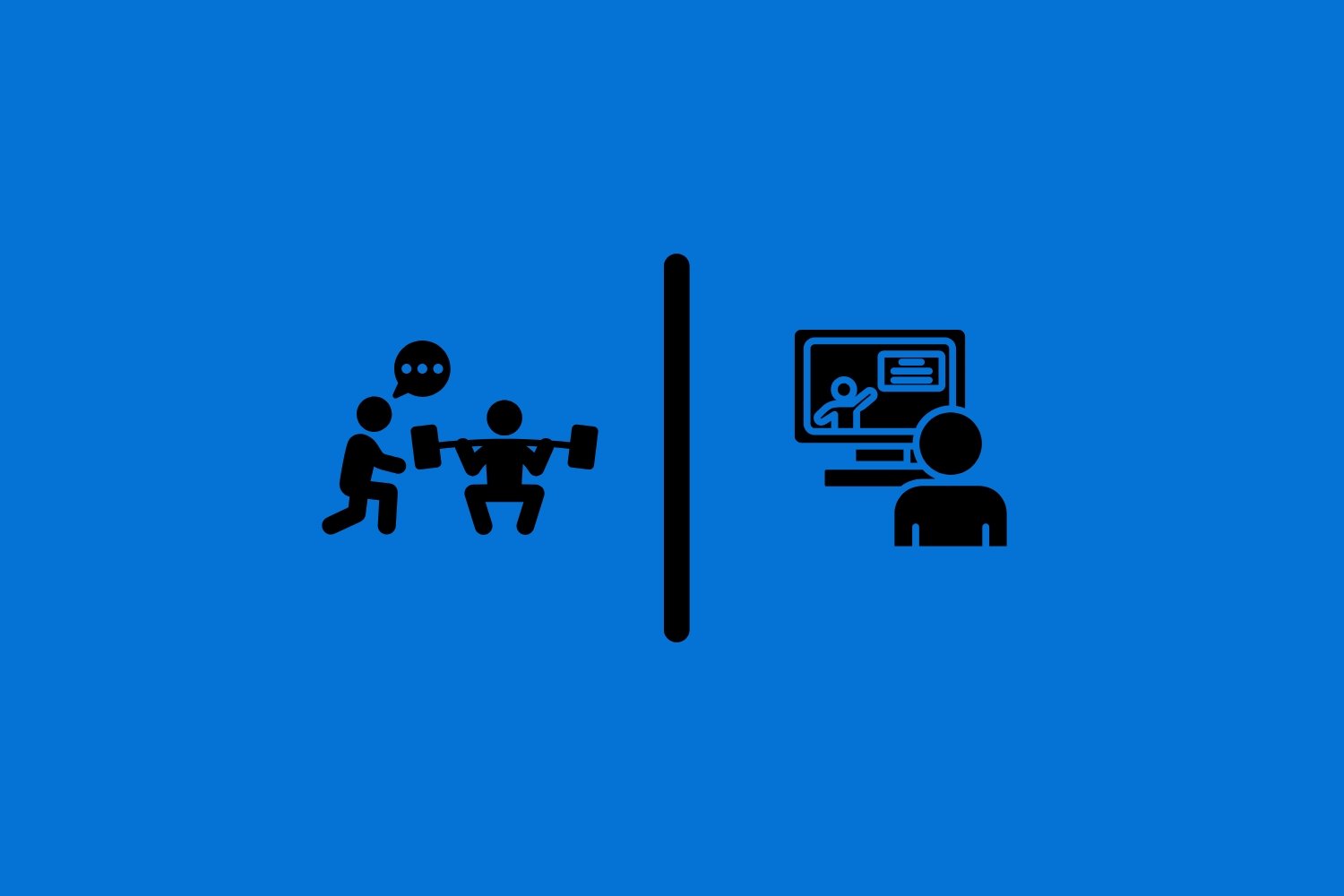
Online PT Vs Face-to-Face Training | Pros, Cons & Prices
What You Get and What It Costs
Online personal training in the UK costs roughly £70 to £300 a month. A face-to-face personal trainer costs roughly £20 to £50 a session, which works out to £200 to £430 a month if you train twice a week. The trade-off is live supervision while you lift vs continuous online support.
I do this for a living and have been a leading online personal trainer here in the UK for over a decade now, so I am not neutral. What follows is the honest version anyway, including the parts where a face-to-face trainer is absolutely the better choice.
Personal Training Industry Standards
One-to-One Personal Trainer Quality
Now, you can’t beat the coaching power of a face-to-face coach; the challenge is finding a coach local to you with the skills required to help you achieve your goal. If you’re a Personal Trainer reading this, you will likely agree that the industry is full of coaches that can’t coach.
Online Personal Trainer Quality
Now, as much as you can’t beat having a coach face-to-face, with constantly evolving technology, it’s becoming easier and easier to coach clients online with an incredibly personal touch. The future is very promising. I personally send clients weekly videos of myself going through all aspects of their plan and areas where they need to improve; this shows the client that I’m genuinely checking up on them and that they’re working with me and not just a client care team or AI. With everything being completely online, you, yes YOU, can train with the best Online Personal Trainer in the world for less than what it might cost you to work with a newly qualified PT at your local gym. Just ensure you do your research and work with a qualified PT, and if they’re a certified nutritionist, that’s a bonus!
Personal Training Prices: What Does a 1-1 Trainer Cost in the UK?
Face-to-face personal trainer prices
Where I am based, one-to-one sessions are between £20 and £50. In more affluent areas, that can double. The UK average sits at about £35 a session, and in London you are typically looking at £40 to £65. At my own gym in Chester, I charge £50 a session, so I am quoting from experience rather than guessing.
Two sessions a week at the average UK PT rate, you’re looking at £303.33 per month, which isn’t cheap, and that is before your gym membership.
What a 12-week programme costs
Twelve weeks is the most common block people ask about. At the £35 UK average, training twice a week, you are looking at £840 for the twelve weeks, plus membership. Some trainers sell twelve-week packages at a discount to the session rate, so treat that as a ceiling rather than a fixed price.

Online Personal Training Prices: Breaking Down the Tiers
Online coaching runs from about £70 to £350 a month, and splits into three rough tiers:
£20 to £80 a month: Usually an app, a template programme and occasional contact. Some of these are honest budget products – new trainers gaining experience or trying to stand out with cheaper rates, but many are just a recycled plan on an email series with a coach's name attached. Below about £70 a month, the numbers stop adding up for a coach to give you real attention. That is worth knowing before you buy on price.
£150 to £220 a month: The standard tier, and where most genuine one-to-one coaching sits. A programme built for you, nutrition guidance, weekly check-ins and direct access to your coach.
£250 to £350 a month and up: Daily check-ins, frequent video calls, specialist or rehab programming.
Where my prices sit, and why
Personally, I charge between £165 and £195 a month. Not cheap, but not costing an arm and a leg either. It is the going rate for proper one-to-one coaching with an experienced coach.
What it buys that most of the standard tier does not: I am a personal trainer and an actual certified nutritionist. With most coaches at this price, you get one or the other – meaning your nutrition is either an afterthought or an upsell. Every client I take on gets both from the same person!
£165 a month covers nutrition coaching on its own
£195 a month covers nutrition and a bespoke training programme. The training side adds £30
Compare that with two face-to-face sessions a week at roughly £303 a month plus membership, and the gap is the honest argument for going online.
Is an Online Personal Trainer Worth the Money?
Every coach will tell you the programme is bespoke. Most of them mean it. It is the rest of the service that separates one coach from another, so here is exactly what you get from me:
A full assessment of your goals, training history and dietary preferences.
A bespoke training programme and nutrition plan built from that assessment, with your calories, protein, carbohydrates and fats set out, and which foods to prioritise.
A 20 to 40 minute personal welcome video walking you through your plan and exactly what reaching your goal is going to take.
Everything delivered through the Expert PT app, so your programme, your logging and our messages sit in one place.
A check-in form every Sunday covering scale weight, energy, hunger, recovery, steps and water – and your programme adjusted, if needed, off the back of it.
Weekly in-depth video feedback, flagging what is going well and what to work on the following week.
Frequent contact by text and voice message, and phone or video calls when they would help, rather than on a fixed schedule.
Cancel at any time, with no contract and no commitment beyond the month you are in.
Does it actually work without someone standing next to you?
The fair version of this question is whether online works when there is a real reason to want supervision.
Brett came to me with two bulging discs in his lower back, twelve months of back problems, and at his heaviest at 100kg. He had always trained, but the injury had stopped him doing anything. That is exactly the situation where people assume you need a trainer physically in the room. We worked around it remotely, with filmed lifts and weekly feedback so I could see what he was actually doing rather than what he thought he was doing.
Other results from clients I have coached online:
Akeal lost 25kg of body fat and built a noticeable amount of muscle.
Ashleigh lost over two stone in four months, starting three months after having a baby.
Steven went from 72.3kg to 77.5kg, adding lean mass while losing body fat at the same time.
Aaron completely changed his physique in twelve weeks.
Online Personal Training Vs 1-1 Personal Training: The 3 Genuine Differences
Both models promise the same outcomes: better training, better nutrition, accountability, results. The difference is how it reaches you, how often, and what it costs.
Live form correction. A face-to-face trainer wins this outright in the moment. They see the rep as it happens. Online, you film it, and I review it, which is slower but has an advantage: we both have a recording, eyes on, and I can show you exactly where you're going wrong and what you’re doing right.
How often you are in contact. Face-to-face is one to three focused hours a week and then silence. Online is lower intensity, but it does not stop. For most people, the second pattern changes behaviour more, because the difficult decisions happen on a Friday evening, not during your session.
Who carries the accountability? With a trainer, the appointment does the work. You turn up because someone is waiting. Online, the weekly check-in and feedback does that job, and it asks more of you. If you know you will not train unless someone is expecting you in a room, be honest with yourself about that.
What About the Free Apps?
This is the honest competition. Far more people search for free training apps and free programmes than for any paid coach in the UK.
Free plans work for some people. If you are self-motivated, already know your way around a gym, and your life is predictable, a good free programme will get you a long way, and you should use one.
Two things a free plan cannot do. It does not change when your week falls apart, when your shoulder starts complaining, or when you plateau for a month. And nobody notices when you stop.
Which Route Suits You Best?
Go face-to-face if you have never lifted before and need someone to teach you the movements hands-on, you are coming back from a serious injury and want supervision in the room, or you know you will not train without an appointment in the diary.
Go online if you can already get yourself to a gym, you travel or work irregular hours, you want your training and nutrition handled by the same qualified person, or the cost of two sessions a week is the thing stopping you from hiring anyone at all.
And if you are weighing coaching against training on your own, the question is not whether you could write yourself a programme. It is whether you will keep adjusting it honestly for six months.
You’ll get a lot more for your money with Online Coaching and more guidance towards hitting your goals. Literally all areas of nutrition, training, sleep, and data collection are covered to the highest possible level with online PT. Online coaching can take a real holistic approach and leave no stone unturned.
That said, a big thing you’ll need to be careful with is paying for something that isn’t what you thought it was. A lot of Online Coaches say they provide “the support needed to help you reach your goal”, but often under-deliver. I’ve personally taken the time to trial other Online Coaches to see if they provide the service they promised, and very few did.
The trick is to shop around, look at results and reviews to make the best decision possible.
In my humble opinion, Online Personal Training is better than one-to-one based on the price and the service you’ll receive. With the constant rise and power of technology and AI, the future of the fitness world is incredibly exciting!
Common Questions
⬇️ Is two PT sessions a week enough?
If you are training face-to-face, two sessions a week is the usual minimum for real progress. Any less, and you spend your time re-learning what you did last week. With online coaching, you are not tied to a trainer's schedule. Most of my clients train three or four times a week because the plan is on their phone and they can fit it in when it actually suits them.
⬇️ Is three months of personal training enough?
It depends what you are starting from. Aaron changed his physique in twelve weeks. Ashleigh lost over two stone in four months. Most of the clients on my results page worked with me for three to six months, and plenty stayed longer because the goal moved.
⬇️ How long do clients usually stay, and how many reach their goal?
The industry average for in-person PT is often just a few months before people drop off. My average online client stays for over nine months, and the vast majority hit their primary goal in that time. They stay because the results are real, the contact is continuous, and once they hit their first target, they want to see what else they can achieve.
⬇️ Can I cancel at any time?
Yes. No contract, no minimum term, no commitment beyond the month you are in.