
Dumbbell Exercises for Full-Body Strength Training
If there’s one bit of kit I’d back for getting stronger and leaner at home (or in a busy gym), it’s dumbbells. Simple and effective!
But here’s the thing: owning a weights set and doing a few random reps doesn’t automatically mean you’re strength training. Plenty of people lift weights. Not everyone trains for strength. Strength training is the methodical pursuit of getting stronger over time, with decent form, a plan, and progressive overload.
So in this guide, I’m going to show you the dumbbell exercises I love for full-body strength, how to structure them into a routine, and how to pick the right dumbbell weight so you actually progress.
First, what dumbbell weight should you start with?
I’m not going to tell you “everyone should start with 3kg dumbells” (also yes, the internet really does spell it like that sometimes). The right starting point is the weight that lets you:
hit your target reps with good form
finish the set feeling like you’ve only got 1–3 reps left in the tank
progress week to week without your technique falling apart
As a rough reference, lots of people do well starting with a small dumbbell set (say 3kg, 6kg and 8kg dumbbells) and then building up. If you’re already training, you might jump straight to 20kg dumbbells for lower body work and rows, and use lighter loads for shoulder work.
One important shopping note before you buy anything: check if the listed weight is per dumbbell or total. A “10kg dumbbell set” could mean a 10kg dumbbell pair (two 5kg) or it could mean two 10s. Same story with a “weight set” listing that looks cheap: read what you’re actually getting.
The 5 best dumbbell exercises for full-body strength
If you want full-body strength, you need a few big patterns covered:
Squat (legs)
Hinge (glutes/hamstrings/back)
Core (abs)
Do those consistently, get stronger at them, and you’ll build a seriously good physique and a body that feels capable. That’s the goal.
1) Goblet squat
Grab one dumbbell and hold it close to your chest. Sit down between your hips, keep your feet planted, and stand up tall. If you’re wobbling around, cutting depth to two inches, or folding like a deckchair, the weight’s too heavy right now.
Coaching cue: control the way down, push the floor away on the way up.
2) Dumbbell Romanian deadlift (RDL)
This is your hinge. Two dumbbells at the front of your thighs, soft knees, push your hips back like you’re closing a car door with your bum. The weights slide down close to your legs. Stop when your hamstrings are screaming and your back still feels solid.
Coaching cue: push hips back and chase that stretch in your hamstrings.
3) One-arm dumbbell row
Support yourself on a bench, sturdy chair or even a windowsill, then row the dumbbell towards your hip and lower it under control. If your torso is doing the Harlem Shake, you’re not “going heavy” you’re just making it messy.
Coaching cue: pull your elbow back, pause for half a second at the top.
4) Dumbbell floor press (or bench press)
If you’ve got a bench, great. If not, floor press is brilliant. Lie down, dumbbells by your chest, press up smoothly, then lower with control. The floor takes away the ultra-deep stretch and makes it a bit friendlier for a lot of shoulders.
Coaching cue: wrists stacked over elbows, don’t bounce reps.
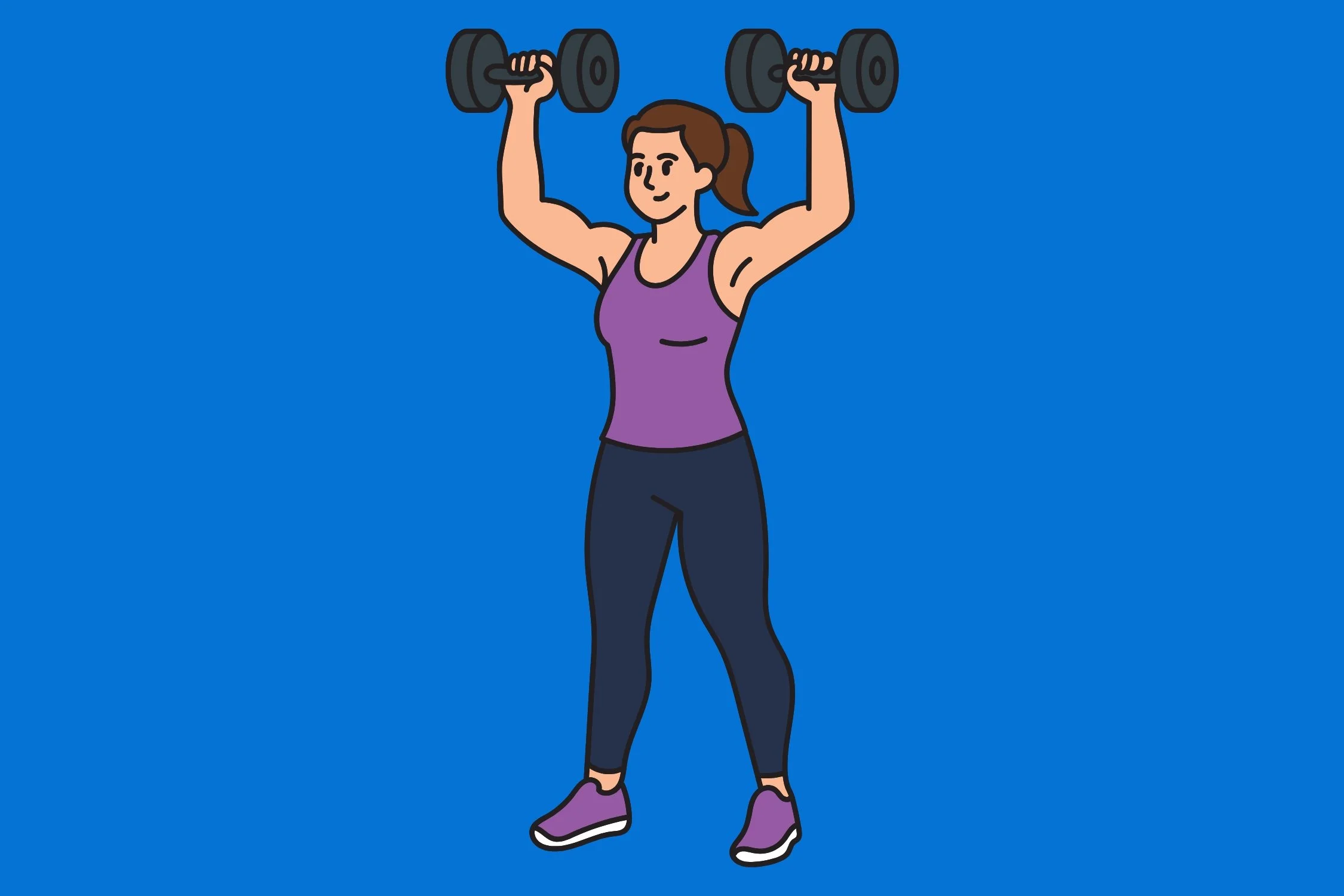
5) Dumbbell shoulder press
Pressing overhead is amazing… as long as you don’t turn it into a standing backbend. Pick a load you can control. If the last rep forces a full-body lean, it’s too heavy for today.
Coaching cue: glutes squeezed, press straight up.
“But what about arms and abs?”
If you get strong at the big patterns above, your arms and core get plenty of work. If you want a little extra, add:
Bicep curls: 8–12 reps, strict
Skull crushers: 8–12 reps, controlled
Otis ups: 10–15 reps, slow
Just don’t let the “extras” replace the main lifts. The main lifts are where the magic happens.
How to programme this into a simple routine
I like keeping things brutally simple.
2–4 days per week (full body)
Goblet squat – 3 sets of 6–12
Dumbbell RDL – 3 sets of 6–12
Floor/bench press – 3 sets of 6–12
One-arm row – 3 sets of 6–12 each side
Shoulder press – 2 sets of 8–15
Otis ups – 2 sets of 10–15
Your job is to keep a log and chase progress without sacrificing form. That’s how you build strength.
Progressive overload (the bit everyone says, but few people do properly)
If you do the same weights, for the same reps, forever… you’ll look and feel the same forever. Progressive overload means you gradually increase:
load (heavier dumbbells)
reps (more reps with the same weight)
sets (more sets and quality work)
control (better tempo, less wobble, cleaner reps)
Most people should live in that sweet spot of 5–15 reps. Lower reps can be great for strength, but they come with higher risk if you’ve not earned the technique yet. Higher reps can build muscle too, but once you’re doing 25–30 reps, it turns into a cardio-and-pain festival that most people don’t need.
Choosing dumbbells: what to buy (without getting ripped off)
If you’re looking at dumbbells for sale or workout weights for sale, here’s what I’d prioritise:
Cast iron adjustable dumbbells: Cheap, cheerful, and effective. The only issue with cast iron dumbbells is they can be fiddly to change weights between sets.
Hex dumbbells: These are amazing and last forever, but they can take up a lot of space and be expensive if you need a few. If you’ve got multiple pairs, a dumbbell tree set is a game-changer for keeping your space tidy. This is the setup I personally have.
Modern adjustable dumbbells with a twist mechanism: You can get dumbbells with quick adjustment, where you simply rotate the handle to change the weight. The drawback is that these dumbbells are capped at a certain weight and are a bit more fragile than other dumbbells, since the twist mechanism can break.
If you have the budget and space, I’d go for classic hex dumbbells with a dumbbell tree. If you’re limited by budget, go for a decent set of cast iron dumbbells. If you have a good budget and very limited space, you might lean toward modern adjustable dumbbells with the twist mechanism.
Safety (because being strong is cool, being injured is not)
Warm up properly, start lighter than your ego wants, and earn the heavier weights. If you’ve got pain, an injury, or you’re unsure about technique, get guidance. Form first, then load.
Summary
Dumbbells are one of the best tools you can use for full-body strength. Pick a few big movements, train them consistently, and focus on progressive overload. Get stronger, feel more confident, and enjoy that moment when the weight that used to make you quiver feels like a warm-up.
If you want a plan tailored for you and your current dumbbell setup, please reach out and check out my online personal training service.