
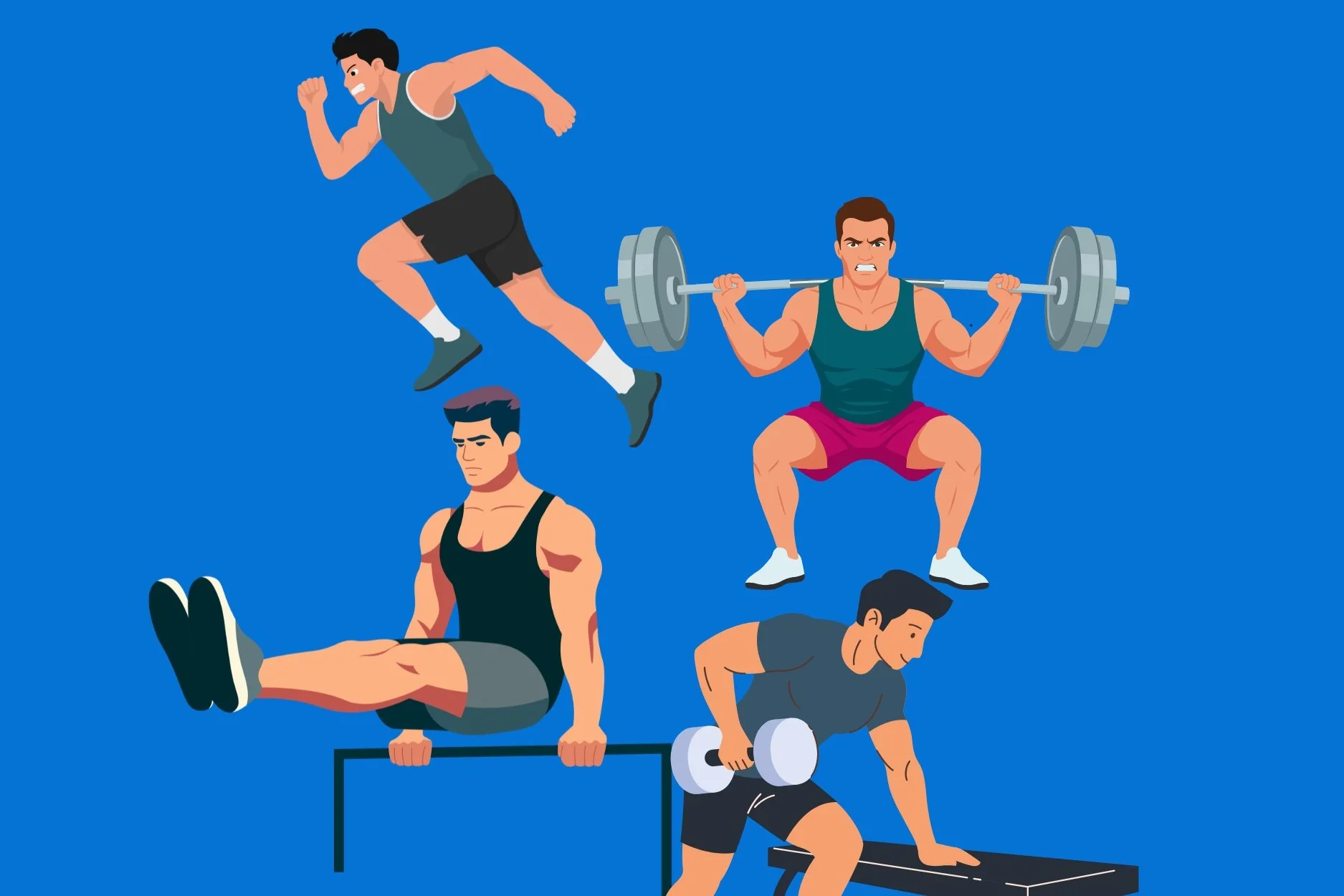
Resistance Training & Cardio
Alright, so we've covered nutrition, calories, and tracking. Now it's time to talk about training – resistance training specifically, and why a sprinkling of cardio deserves its place too.
When it comes to transforming your body composition – getting leaner, more defined, more athletic, or just getting seriously jacked – resistance training is the primary driver.
Prefer to watch than read? Then please check out the video below:
Resistance Training
Resistance training not only facilitates growth but also makes fat loss considerably easier. The more muscle mass we have, the more calories we burn on a daily basis, as muscle tissue is very metabolically active. Additionally, when looking to lose weight, if resistance training is absent, you'll lose muscle in addition to fat – meaning a greater share of your weight loss comes from the wrong place. Resistance training signals to the body that the muscle needs to be kept, so more of that weight loss comes from where we actually want it to – body fat. So whether you're looking to strip fat or get seriously jacked, resistance training is your best friend and allows you to actually target fat loss.
How do you train effectively?
Training effectively comes down to two main things:
Intensity
Volume
Intensity
Intensity first – because this is where most people fall short. To maximise the muscle-building response, you need to train close to muscular failure. Not necessarily all the way there on every set, but close. Think of it in terms of reps in reserve – you want to finish most working sets with no more than a few reps left in the tank. If you're walking away from a set feeling like you had four or more reps available, you've left too much on the table. The reps closest to failure are by far the most effective reps of the set. For isolation exercises – curls, lateral raises, leg extensions – take each set very close to failure, around one to two reps in reserve, with the final set going all the way. As a general rule, that final set of most exercises should be taken to, or very close to, complete failure – not because you've suddenly piled on the weight, but because fatigue has naturally built up across the previous sets – all of which should have been relatively close to failure. That said, for bigger compound movements like squats and deadlifts, where solid technique is essential, leave one to three reps in reserve even on the final set. When fatigue causes form to break down, that's when injuries happen. Which brings me to the one rule that overrides everything else: never let your technique fail in pursuit of muscular failure. The moment your form goes, the set ends – and if it's already gone, you've already risked injury.
Progressive Overload
With intensity comes progressive overload. The body adapts, so you need to keep increasing the demand placed on your muscles over time. Each week, try to add a little weight or squeeze out an extra rep compared to the previous session. If everything feels comfortable and easy, the weight is far too light. Muscles don't develop unless they need to.
Volume
Now, volume. Across my work and the broader literature, a sensible target is 10–30 hard sets per muscle per week. Most lifters live happily in the 10–20 pocket; the high-end (20–30) is for advanced, resilient humans and short blocks. Beyond 20 sets, you're typically into diminishing returns territory. It's also worth noting that, per session, gains tend to plateau after about 6 hard sets per muscle. So rather than cramming all your weekly volume into one session or completely annihilating a single muscle group during one session, spread the volume across multiple sessions through the week – you'll get more out of each set and recover better between sessions. Progress your volume steadily over time rather than jumping aggressively; your joints will thank you.
Cardio
Now, cardio. Even if your goals are purely aesthetic, cardio earns its place. It contributes meaningfully to your weekly energy expenditure, which supports fat loss. And even if fat loss is not your goal, cardiovascular fitness is a genuine health marker – it strengthens the heart, lowers resting heart rate, and improves your ability to rep out in the gym. Not sure about you, but I’ve had it when, on my final set of back squats, I’ve literally just gassed out. My legs could push on, but my cardiovascular fitness was just not there. We don’t want to lose out on reps and gains just because we’re unfit. A couple of moderate sessions per week are plenty, or even just a bit of intervals at the end of some of your resistance sessions. Brisk walking also counts. A good-paced walk where you're breathing a little harder but could still hold a conversation is ideal. It's low-stress, sustainable, and genuinely effective.
Summary
Cardio and resistance training aren't competing with each other – they're complementary. Use your resistance sessions to build and maintain muscle; use your cardio to support your health, your calorie balance, and your overall fitness.
Train hard, train smart, and focus on performance improvements over time 👍