

A scientific report has proven the benefits of HIIT, which will come as good news to most of us who are short on time.

First of all, let’s check out wikipedia’s definition of overtraining “Overtraining occurs when a person exceeds their body's ability to recover from strenuous exercise”
I couldn’t have said it better myself!
Fatigue
Persistent muscle soreness
Increased resting heart rate
Getting ill more frequently
Consistently carrying injuries
Irritability
Depression
Loss of motivation
Insomnia
Decreased appetite
Now, the main reason this happens is from under recovering and too much training volume, you need to make sure you have enough rest with adequate calories and a high-quality diet to fuel the recovery process.
The best cure is always prevention:
You can train hard or you can train long, but you can’t do both, for those of you who say you train for 2 hours at a HIGH intensity are most likely lying, genetically gifted, on steroids or all three.
Rest at least 1 day per week for advanced athletes, but if you’re a beginner you’ll need 2-3 days of rest per week. Personally, I train 4 times per week, as long as the intensity is high enough and you’re progressively overloading your training, then it will be sufficient to induce the change needed to develop.
You can go get yourself a nice massage or spend a bit of time each day doing some foam rolling.
As previously mentioned, calories are very important, if you want to develop your muscles and performance then you need to have enough calories coming in. It's important to ensure that a diet high in carbohydrates, lean proteins and healthy fats such as omega 3 oils.
If you have a vitamin deficiency then you may be seeing signs of overtraining. I would recommend taking a good quality multivitamin as a nutritional safety net.
Don’t try and build size, increase your 1 rep max deadlift whilst training for a marathon, I’m not saying it’s impossible to do all this at once, it’s just highly improbable and it’s not as optimal. This will result in you making little to no progress in each area. The better alternative is to focus your training phases on prioritising an objective, whether that’s building muscle, strength, endurance or reducing body fat percentage. It’s difficult to build muscle and lose fat at the same time as your body needs to be in two different states, anabolic for muscle building and catabolic for fat loss. Also, it’s difficult to build a large amount of strength and endurance at the same time as this works two different muscle types, you don’t see Eddie Hall running the London Marathon and you don’t see Sir Mo Farah deadlifting 500kg.
Having said all that, it’s difficult to find people who are overtrained away from the world of athletes, it’s more likely people are showing signs of overreaching, which is more common and takes less time to sort out. This is because us mere mortals don’t train that frequently, athletes will train on the border of overtrained and can sometimes push past that threshold, which can lead to injury long term.
Personally, I’ve only overtrained or more likely overreached once when I had to lose 10kg in 6 weeks for a boxing match whilst serving in the Army. I was training 4 times per day, 10-mile run in the morning, followed by boxing skills before lunch, followed by boxing circuits after lunch and then sparring in the evenings. It’s no wonder I was carrying numerous injuries and felt incredibly weak….. still kicked ass though.
If you’re feeling like you’re overtrained or overreached, then just take a step back by reducing volume, reassess your calories and macronutrients, take a couple of days off training or maybe even a week if needed. Once you’re feeling like yourself again, it’s time to get back on track.
“Progressive overload requires a gradual increase in volume, intensity, frequency or time in order to achieve the desired goal of the user. In this context, volume and intensity are defined as follows: Volume is the total number of repetitions multiplied by the resistance used as performed in specific periods of time.”
Progressive overload is absolutely key to your training programme, regardless of your goal, be that strength, hypertrophy or endurance. Without progressive overload, your body will progress and develop to a point, but if you want to see further development then you need to exert greater demand on the body by training hard and training smart. If you don't progressively overload the muscles by forcing them to do more than they're accustomed to, then they have no reason to make further adaptations.
Think about it this way, if you go to the gym and do the same exercises with the same amount of reps, sets and resistance, then run 1km at the exact same pace each time, do you think your body will develop? Does it need to?
The answer is NO, your body will not develop unless it needs to! The body needs to be incrementally challenged in a structured manner in order to see continuous improvements in performance.

Increasing the resistance/load is the most common and effective way of progressively overloading a muscle. To give you an example, week one you complete 4 sets of 8 reps on the back squat using 100kg and week two you perform the same amount of reps and sets, but you increase the load up to 110kg, this is the simplest form of progressive overload, progressively increasing the load in order exert greater demand on the muscles.

Consider our example of the back squat again, instead of adding additional load, you could instead perform 4 sets of 10 reps, rather than the initial 8 reps.
Note that with this method, you're limited as you should train within certain rep ranges specific to your goals, for example, if you were training for strength you would not want to incrementally increase the reps until you're hitting 15 + reps as you would then be moving towards muscular endurance. You would increase another variable, like load, frequency or time as this is more aligned to your goal.
On that note, below are the recommended rep ranges for several common goals:
Strength 4-8 reps
Hypertrophy (muscle building) 8-15
Muscular endurance 15 reps +
These are based on the conclusions of a meta analysis by Brad J Schoenfield et al, who found that lower reps with higher weight leads to increased strength, whereas higher reps with lighter weight led to hypertrophy. As you’d imagine, the rep range for endurance is the highest, which echos the findings of a randomised controlled trial by Gerson E Campos et al from the European Journal of Applied Physiology, who found that higher rep ranges lead to the individuals who are better adapted for submaximal prolonged contractions and increased aerobic power and time to exhaustion.
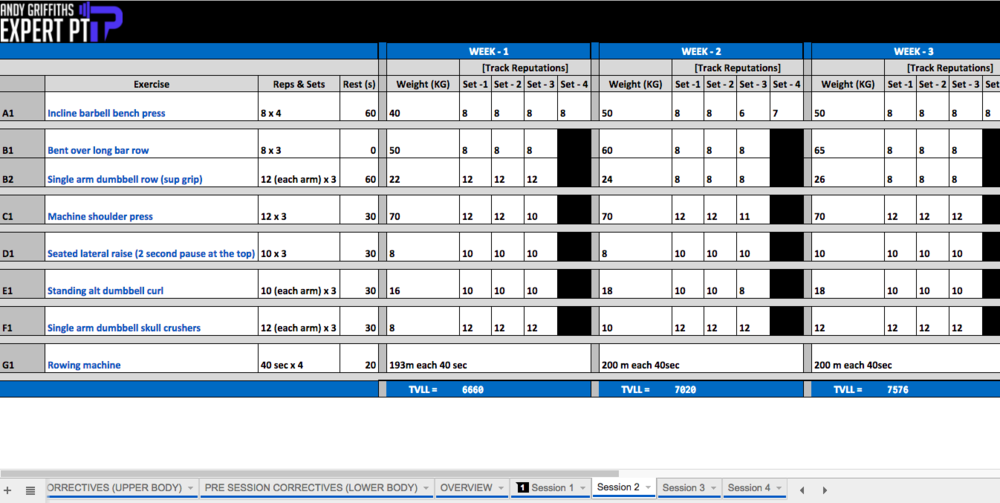
Volume is simply sets multiplied by reps multiplied by resistance. You can increase demand on your body and muscle groups by adding more exercises, reps or sets. Instead of performing the 100kg back squat for 4 sets of 8 reps, you can do it for 5 sets of 8 reps. Alternatively, you can lift the same weight, reps and sets, but add in an additional exercise that targets the same muscle group, for example, you could superset your back squats with lunges..... if you're feeling brave.
In a review by William J Kraemer et al from The American College of Sports Medicine, it was recommended that changes in total training volume (reps, sets, load) be made in increments of 2.5% to 5.0% per week to avoid the possibility of overtraining.

Increasing the training days per week is a very simple and effective approach, but is limited as you need to take sufficient rest days in order to recover and grow. Training needs to enrich your life, not take over it and overtraining can have a detrimental effect on your progress.

This is one of my personal favourites, especially with busy clients who have limited time per session to train. It’s a great way to achieve more volume per session, equating to a significant increase in total volume per week. This can be achieved either through less rest between sets, or by using a training system, such as supersets or tri-sets, where there is no rest between different exercises. This allows you more time to adequately train multiple muscle groups within a session but sets per muscle group should be kept at an appropriate, optimal level for you. The only drawback to limiting rest relates to those training specifically for strength gains; it's vitally important that you have adequate rest between sets in order to sufficiently recover for the next heavy set - you’ll need to be ready for it.
First and foremost, progressive overload is key, regardless of your goal; it’s the catalyst for seeing real progress and pushing the body to do more. There are several ways in which to elicit progressive overload at our disposal, but it’s vital these are fully understood so you can engage the method which is best aligned to your goals, lifestyle and training experience.
If you are looking for an Online Personal Trainer who can provide a bespoke training plan, with progressive overload at its core, sign up today.


