

Many women don't want to quit their fitness regime when pregnant, so here are some expert tips on how to keep exercising right up until you give birth!

First of all, let’s check out wikipedia’s definition of overtraining “Overtraining occurs when a person exceeds their body's ability to recover from strenuous exercise”
I couldn’t have said it better myself!
Fatigue
Persistent muscle soreness
Increased resting heart rate
Getting ill more frequently
Consistently carrying injuries
Irritability
Depression
Loss of motivation
Insomnia
Decreased appetite
Now, the main reason this happens is from under recovering and too much training volume, you need to make sure you have enough rest with adequate calories and a high-quality diet to fuel the recovery process.
The best cure is always prevention:
You can train hard or you can train long, but you can’t do both, for those of you who say you train for 2 hours at a HIGH intensity are most likely lying, genetically gifted, on steroids or all three.
Rest at least 1 day per week for advanced athletes, but if you’re a beginner you’ll need 2-3 days of rest per week. Personally, I train 4 times per week, as long as the intensity is high enough and you’re progressively overloading your training, then it will be sufficient to induce the change needed to develop.
You can go get yourself a nice massage or spend a bit of time each day doing some foam rolling.
As previously mentioned, calories are very important, if you want to develop your muscles and performance then you need to have enough calories coming in. It's important to ensure that a diet high in carbohydrates, lean proteins and healthy fats such as omega 3 oils.
If you have a vitamin deficiency then you may be seeing signs of overtraining. I would recommend taking a good quality multivitamin as a nutritional safety net.
Don’t try and build size, increase your 1 rep max deadlift whilst training for a marathon, I’m not saying it’s impossible to do all this at once, it’s just highly improbable and it’s not as optimal. This will result in you making little to no progress in each area. The better alternative is to focus your training phases on prioritising an objective, whether that’s building muscle, strength, endurance or reducing body fat percentage. It’s difficult to build muscle and lose fat at the same time as your body needs to be in two different states, anabolic for muscle building and catabolic for fat loss. Also, it’s difficult to build a large amount of strength and endurance at the same time as this works two different muscle types, you don’t see Eddie Hall running the London Marathon and you don’t see Sir Mo Farah deadlifting 500kg.
Having said all that, it’s difficult to find people who are overtrained away from the world of athletes, it’s more likely people are showing signs of overreaching, which is more common and takes less time to sort out. This is because us mere mortals don’t train that frequently, athletes will train on the border of overtrained and can sometimes push past that threshold, which can lead to injury long term.
Personally, I’ve only overtrained or more likely overreached once when I had to lose 10kg in 6 weeks for a boxing match whilst serving in the Army. I was training 4 times per day, 10-mile run in the morning, followed by boxing skills before lunch, followed by boxing circuits after lunch and then sparring in the evenings. It’s no wonder I was carrying numerous injuries and felt incredibly weak….. still kicked ass though.
If you’re feeling like you’re overtrained or overreached, then just take a step back by reducing volume, reassess your calories and macronutrients, take a couple of days off training or maybe even a week if needed. Once you’re feeling like yourself again, it’s time to get back on track.
[Full Body Workout]
A1 - Barbell/Dumbbell Split Squat (6 each leg x 4)
A2 - Incline Dumbbell Row (8 x 4)
___________________
B1 - RDL’s (10 x 3)
B2 - Seated Arnold Press (10 x 3)
___________________
C1 - Dumbbell Alt Bicep Curls (10 each arm x 3)
C2 - Seated Tricep Press (12 x 3)
[Total Time 40 - 45 minutes]
Summers coming and this is the time of year is when my inbox is full of people asking me what the best rep ranges for fat loss are.
The reason this is something that people just don’t fully understand is that it’s not simply black and white, however, that doesn’t stop people from saying “high reps are for muscle toning and low reps are for strength and muscle gain”, what the hell is muscle toning anyway?? You can’t just train a muscle to look toned, muscles will hypertrophy (get bigger) or atrophy (get smaller), you can’t train a muscle to look toned, the “toned” look comes from having a lower % body fat that reveals the muscle definition, aka shredded!
Let me start by breaking down some rep ranges for you:
Burn more calories
Increase muscular endurance
Improve aerobic capacity

Muscle building (sarcoplasmic hypertrophy)

Strength (myofibrillar hypertrophy)
Increase neuromuscular drive
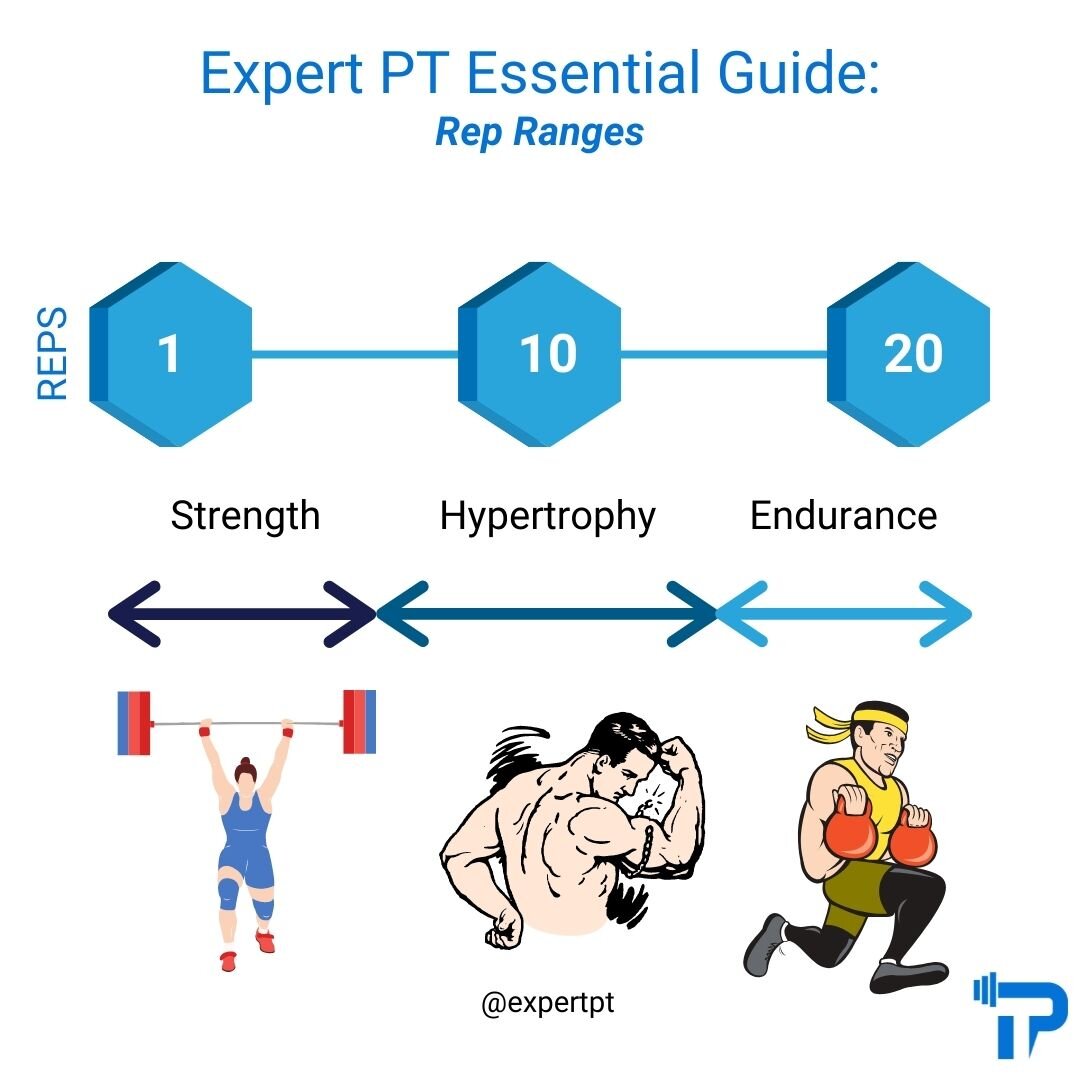
Okay, so if my goal is fat loss then it makes sense for me to perform a higher amount of reps to burn more calories, correct? Well not really!
If you want to lose fat, you should be trying to develop a decent amount of muscle tissue (in the gym), the more muscle you have, the faster your metabolic rate. 6-12 reps are gold when it comes to hypertrophy (muscle development). You can very effectively hit all three mechanisms of hypertrophy (three mechanisms of developing muscle):
- Mechanical tension (high resistance)
- Metabolic stress (pump/cell swelling)
Okay, so if my goal is fat loss then it makes sense for me to perform between 6-12 reps, correct? Well not really!
Possibly the biggest factor when it comes to muscle building is mechanical tension, putting enough resistance through your muscles to force them to develop. You will need to use heavyweight, therefore you’ll need to perform fewer reps (4-6 reps) to optimise this mechanism.
Okay, so if my goal is fat loss then it makes sense for me to perform between 1-6 reps and life heavier, correct? Well not really!
You’ll need to have plenty of rest between sets when lifting very heavy, so you won’t be burning a high amount of calories.
I can hear the shouts....”Andy……I’m confused…..How many reps will help me to lose fat??’
Well, you need an element of all three. You can include each element in each of your gym sessions or a more effective plan would be to incorporate this through phases/cycles.
- Month one mainly higher reps with the odd strength session
- Month two mostly medium reps with the odd bit of strength work
- Month three should be strength-focused, I don’t mean spending the full session training between 1-6 reps, instead start the session with heavy compound exercises like squats or deadlifts (after your warm-up of course), then increase the reps through the session. Once you come to the end of this phase you should have increased strength, that would be the goal of this phase.
Here is an example of how you could structure these sessions:
A1 - Leg press - 12 reps x 3
B1 - Cable row - 12 reps x 3
C1 - 45 degree hip extension - 12 reps x 3
D1 - Seated shoulder press - 15 reps x 3
E1 - Lateral raises - 15 reps x 3
A1 - Front squat - 10 reps x 3
B1 - Bent over row - 10 reps x 3
C1 - Lying leg curls - 10 reps x 3
D1 - Military press - 10 reps x 3
E1- Horizontal cable pull - 12 reps x 3
F1 - Dead bugs - 15 (each side) x 3
A1 - Barbell back squat - 6 reps x 5
B1 - Cable pull down - 8 reps x 4
C1 - RDL’s - 8 reps x 4
D1 - Barbell bench press - 10 reps x 4
E1 - Cable tricep push down 12 reps x 3
F1 - Rowing machine 200m x 5
You can see by these examples that we are not pushing to the extremes, we are not focusing on doing 20 plus reps and we're not doing a 1 rep max set, instead, we're keeping within a set range dependant on our phase objective, this is between 6-15 reps.
Now, a big thing you need to consider when putting your training plan together is how likely you are to stick with that plan, if you do the same session every single day then this will be completely soul-destroying. You need to consistently mix it up (month by month) allow every workout to take you one step closer to where you want to be.
Now, in order to maximise your potential, you'll need to support your training with a nutrition plan, calorie intake and macros breakdown specific to your goals.
If you wish to take your training and nutrition to the next level you can request a free consultation where I can advise you on the best training methods specific to your goals, along with some advanced dietary strategies, you just need to fill in the form below...
You no longer need to keep stressing over this, as it will, without doubt, be one of these three issues:
Once you have ruled out number three with a trip to the GP, you can be quite sure that it’s number 1 or 2, or likely a mixture of the two. This might feel like some harsh truths, but the amount of people who have started working me with the illusion that they have tried everything is simply unbelievable.
I know far too many people who are struggling and getting frustrated that they’re not losing fat but have no idea how many calories they’re consuming each day, this is like complaining that the recipe you followed tastes like crap, yet you didn’t actually follow the instructions.
Let’s step into the shoes of someone who has “tried everything”, they don’t drink much, they train 4 times per week and hardly eat at all.
This is usually what this person week looks like:
- They don’t eat much…yet each evening they have a dessert containing upwards of 500 calories.
- They train four times per week…yet they don’t follow a plan, so they don’t train at all, they workout 4 times a week, trust me there is a difference.
- They don’t drink much…yet this weekend they did get drunk because it was their best friends birthday, actually the weekend before they celebrated a christening…..you can see where I’m going with this.
Let’s say your evening treat adds up to 300 calories, you have that 5 days a week, it ends up being 1,500 calories, now let’s factor in the 4 Jaeger Bombs on the weekend (632 calories)….. I love Jaeger Bombs…and then the 4 pints (720 calories). Oh, let’s not forget the Big Mac meal you had as a “1 off treat” (1,120 calories). Maybe this is an exaggeration….maybe not, but you can see how easily a week can escalate, due to these little extras we have added an extra 3,972 calories to our week!
A big issue I find is that people who eat like this think it’s normal, they think that they have just been dealt a slow metabolism hand. “All my friends are stick thin and they eat the same as me”, how do you know the eating habits off all your friends? Yes, they might go out every weekend the same as you, but they are a lot more active in the week as they don’t have an office job, or they only have an evening treat on a Friday, yet you have one every day. People will see a snapshot of someone’s life and think it’s their normality.
Let’s take me for example, I eat out most days on the weekend, and I’ll likely treat myself to the odd Costa panini and maybe the odd chocolate in the week. However, I train 4 times a week…. I mean properly train, I drink a ton of water, I’m very active through the days, most months I don’t drink any alcohol, my regular meals and my calorie intake are inline with my goals.
So, this is not me saying that you should completely eliminate all these treats because as you can see, I don’t! What I am saying is that you need to be a bit more self-aware of what you’re doing through the week and how that will affect your body composition. You need to take control of your body and mindset and not let anything hold you back from what you’re aiming to achieve!

