Training Plan Template

What makes a good training plan?

I often get asked how I structure my training plans, now this is something that will be completely tailored to the individual, we have got to take their age, weight, training experience, goals, posture and movement patterns into consideration. Having said that, I’ve put together a workout plan here that will give you a good idea as to how to structure your fat loss training plan to help reach your body composition and fitness goals.
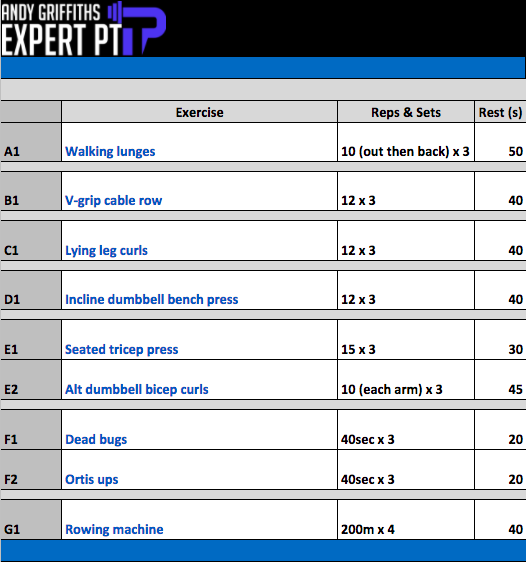
A1 - Dumbbell walking lunges | 10 Reps x 3 | 50 seconds rest


B1 - V-grip cable row | 12 Reps x 3 | 40 seconds rest


C1 - Lying leg curl | 12 Reps x 3 |  40 seconds rest


D1 - Incline dumbbell bench press | 12 Reps x 3 | 40 seconds rest


E1 - Seated tricep press | 15 Reps x 3 | 30 seconds rest

E2 - Alt dumbbell bicep curls | 10 Reps (each arm) x 3  | 45 seconds rest


F1 - Dead bugs | 40 seconds x 3 | 20 seconds rest

F2 - Ortis ups | 40 seconds x 3 | 20 seconds rest

G1 - Rowing machine | 200m x 4  | 40 seconds rest

Online Personal Trainer

Once you have completed your workout you should be feeling awesome! 

You might now be thinking how you can design your own plan, well if this is the case we need to look into what the prefect rep range might be.

This is a very common question and it’s not the first time I’ve touched on this subject.

Let’s get straight into it.

High Reps (12-15):

Burn more calories 

Medium Reps (8-12):

Optimise muscle building 

Low Reps (4-8):

Strength

Okay, so if my goal is fat loss then it makes sense for me to perform a higher amount of reps to burn more calories, correct? Well not really!

If you want to lose fat, you should be trying to develop a decent amount of muscle tissue (in the gym), the more muscle you have, the faster your metabolic rate. 8-12 reps are gold when it comes to hypertrophy (muscle development). You can very effectively hit all three mechanisms of hypertrophy (three mechanisms of developing muscle):

- Mechanical tension (high resistance)

- Metabolic stress (pump/cell swelling) 

- Muscle damage (stretch)


Okay, so if my goal is fat loss then it makes sense for me to perform between 8-12 reps, correct? Well not really!

Possibly the biggest factor when it comes to muscle building is mechanical tension, putting enough resistance through your muscles to force them to develop. You will need to use heavyweight, therefore you’ll need to perform fewer reps (4-8 reps) to optimise this mechanism.


Okay, so if my goal is fat loss then it makes sense for me to between 4-8 reps and lift heavier, correct? Well not really!

You’ll need to have plenty of rest between sets when lifting very heavy, so you won’t be burning a high amount of calories.


I can hear the shouts....”Andy……I’m confused…..How many reps will help me to lose fat??’


Well, you need an element of all three. You can include each element in each of your gym sessions e.g heavier at the start, or a more effective plan would be to incorporate this through phases /cycles. 


Example: 

- Month one mainly higher reps with the odd strength session

- Month two mostly medium reps with the odd bit of strength work

- Month three should be strength-focused, I don’t mean spending the full session training between 4-8 reps, instead, start the session with heavy compound exercises like squats or deadlifts (after your warm-up of course), then increase the reps through the session. Once you come to the end of this phase you should have increased strength, that would be the goal of this phase.


Here is an example of how you could structure these sessions:

Month one full-body example session:

A1 - Leg press - 12 reps x 3

B1 - Cable row - 12 reps x 3

C1 - 45 degree hip extension - 12 reps x 3

D1 - Seated shoulder press - 15 reps x 3

E1 - Lateral raises - 15 reps x 3

Month two full-body example session:

A1 - Front squat - 10 reps x 3

B1 - Bent over row - 10 reps x 3

C1 - Lying leg curls - 10 reps x 3

D1 - Military press - 10 reps x 3

E1- Horizontal cable pull - 12 reps x 3

F1 - Dead bugs - 15 (each side) x 3

Month three full-body example session:
Online PT.jpg

A1 - Barbell back squat - 6 reps x 5

B1 - Cable pull down - 8 reps x 4

C1 - RDL’s - 8 reps x 4

D1 - Barbell bench press - 10 reps x 4

E1 - Cable tricep push down 12 reps x 3

F1 - Rowing machine 200m x 5

Now, a big thing you need to consider when putting your training plan together is how likely you are to stick with that plan, if you do the same session every single day then this will be completely soul-destroying. You need to consistently mix it up (month by month) allow every workout to take you one step closer to where you want to be.


Disclaimer - You must consult with a medical or fitness professional before starting any new exercise and nutrition programme.

Do you need to mix up your workouts?

Do you need to mix up your workouts?

The short answer to this is “NO you do not”, but as always I’m going to go into more detail so you fully understand why. 

First of all, let’s look at the pros of mixing up your workouts:

  • Keeps things exciting

  • Can optimise muscular damage (mechanisms of muscle development).

Now let’s look at the cons:

  • It’s almost impossible to track progressive overload (progression with the weights/strength)

  • You generally end up doing the same shit each week, even if the days are different, the weeks and months end up being about the same.

Let’s take this to the extreme, on the one hand, we have boring Bob who does the exact same session each time he trains, it’s a full-body split with a 500m row at the end. On the other hand, we have Jimmy Spandex who does a different session every time he trains. 

Now as boring as Bob’s session is, he’s more likely to improve as he can accurately track his progress. As much as Jimmy is a fun guy, it will be much more challenging for him to accurately track his progress and he would likely be using the same weights each week.

Now, results are not everything, nor am I suggesting you do the same boring shit each time you train. So here is the solution - Design a plan that is based around your goals, have a different session for each day of the week, but continue that plan for 4-6 weeks, this allows you to accurately track progression and allows you to compete with yourself. Essentially, if you know how you performed last Monday, how much you squat, how fast you ran, then you’re likely going to want to beat those times. Once you have done 4-6 weeks, change up the plan, but maybe increase volume, this is the basic fundamentals of programming.

In summary, doing a random session each time you train means you’re not training, you’re working out, working out gets you results, but training gets you to your desired goal.

NOT For Everyone

Why Online Personal Training Is NOT For Everyone!

Online Personal Trainer.png

Now, I’m writing this article to help those of you who are interested in Online Personal Training to weigh up the pros and cons of this type of product. I hope this info will also help other Online Personal Trainers to inform their potential online clients, helping them to ensure their clients choose the right product for them. 

First of all, what is Online Personal Training?

Online Personal Training is a new and exciting way to offer Fitness Coaching and achieve life-changing transformation with clients. It can be utilised by anyone, anywhere, offering convenience, responsiveness, flexibility and affordability. 

Who is it for and not for?

Online Personal Training is for people with a basic to a high level of knowledge regarding exercise physiology. It’s not always ideal for people who have never looked at a dumbbell, having said that, I’ve worked with some incredible clients who have gone from, shall we say ‘zero to hero’. If you have not exercised before, you’ll likely be better off working with a one to one Personal Trainer, this is so that they can accurately assess your form and movement patterns. With Online Personal Training you’ll not be seeing someone in person, for this reason, it can be easier to hide away and avoid training and dieting, therefore, if you know that you seriously lack self-discipline you might be better off working with someone one to one. 


Online Pros & Cons

Pros

  • Cost-effectiveness - Prices are generally around £70 to £160 per month, when we compare this to one to one PT, it’s less than half the price

  • Knowledge and experience - With Online Personal Training, it means you can work with the best in the world, from anywhere in the world

  • Guaranteed Nutrition Plan - With a lot of one to one PT’s you’ll not receive any kind of nutrition guidance, with online coaching they’ll generally give you a full nutrition plan and track it 100%

  • Guaranteed Training Plan - This might sound crazy, but a lot of one to one PTs don’t give their clients a plan, or even have a plan, often it’s whatever they feel like doing on the day, we know that just doing random sessions with no structure or tracking is not the best way to work towards the desired goal

Cons

  • No direct coaching on form - Most good Online Personal Trainers will have video demos in place, but sometimes that’s not enough for individuals to master the correct form

  • Not working directly with your Coach - A lot of big-time Online Coaches have a very automated system, or they have a team working with clients on their behalf, so you’re not always working directly with your desired coach. However, this is not always the case and you simply need to be selective when picking your Online Coach

  • You'll need to have more self-drive - With Online Coaching you do not have a Personal Trainer waiting for you at the gym, so you need to be a lot more motivated to get yourself to the gym and pursue your goals


Is it for you?

Now that we have gone through all the potential benefits and potential downsides, let’s see if Online Personal Training for you……
If you feel like you can accurately track your training using the systems provided, you have the discipline to track your nutrition daily, and the motivation to push yourself with the plan you have been prescribed, then Online Personal Training is definitely for you!

[Story Time] - Cardio vs Weights

Cardio vs Weights

Online Personal Trainer.jpg

So, I’m in the gym minding my own business, shoulder pressing the 50’s..... okay the 25’s, and a guy on the bench next to me says “they’re not going to get anywhere doing that are they!?”

Now, as I looked, I could see he was referring to the people on the treadmills.
I believe he was suggesting that they will not achieve great physiques by just walking on treadmills, he might be right, if he was suggesting that they’re not going to cover any real distance whilst walking on a consistently revolving running belt, then he is definitely right! From his tone I highly doubt the latter, although that is a new gym joke people can now use, you’re welcome.

I was wondering why he was trying to have this conversation with myself, he didn’t know me nor my opinions on cardiovascular exercises. I can only assume he was talking to me because at this point there was a copious amount of blood pumping into my shoulders due to the 50’s.....25’s, this made them shine like Orion’s Belt, he must have thought, this guy knows his shit. I responded with a smile and a slight nod, this isn’t because I agree with such judgmental beliefs, I’m just a nice guy. It did, however, get me thinking, how does he know what everyone’s goal is?
Maybe, that person wants to be able to walk 1km on a 10-degree incline at an average speed of 1km an hour, if that’s the case they’re all fucking smashing it!
Maybe they prefer having a slightly above average body fat percentage.
Maybe, this is the only time they have away from family and work stresses and they just want to walk on a treadmill, turn their brain off and watch Jeremy Kyle on the gyms big screen.

Now, all joking aside, none of us know the goals of people in the gym, some people just want to move more and be a bit healthier, and that’s awesome!!

The gym can be a scary place for a lot of people and it becomes scarier when people are openly judging them!

If we look at what is optimal, then cardio can be great for fat loss and body composition. Weights can be great for fat loss, body composition, strength and are generally more beneficial long term, so generally more optimal for most people, but nutrition is what will fuel the changes. Having said that, we all have got to take the journey that we enjoy and we’ll stick with! Health and fitness aren’t just about trying to look a certain way, it’s about constantly trying to improve yourself, investing in yourself, and becoming the strongest version of yourself both physically and mentally!

P.S for my clients reading this thinking “Hey Andy! You always give me a hard time if I don’t train right!” Yes, this is true, but I know your goals and it’s my responsibility to get you there 💪